
Industrial and outdoor environments place unique demands on display technology. Screens must remain readable in direct sunlight, operate reliably across wide temperature ranges, and withstand continuous use in harsh conditions. As human–machine interfaces (HMIs) become more central to systems and installations, selecting the right display technology becomes a critical engineering decision.
Two display technologies dominate these discussions: TFT LCD and OLED. Both offer strong performance characteristics, but they behave very differently under industrial and outdoor operating conditions. Understanding those differences helps engineers and product designers choose the most suitable option for their application.
Understanding TFT LCD and OLED Displays
TFT LCD Displays
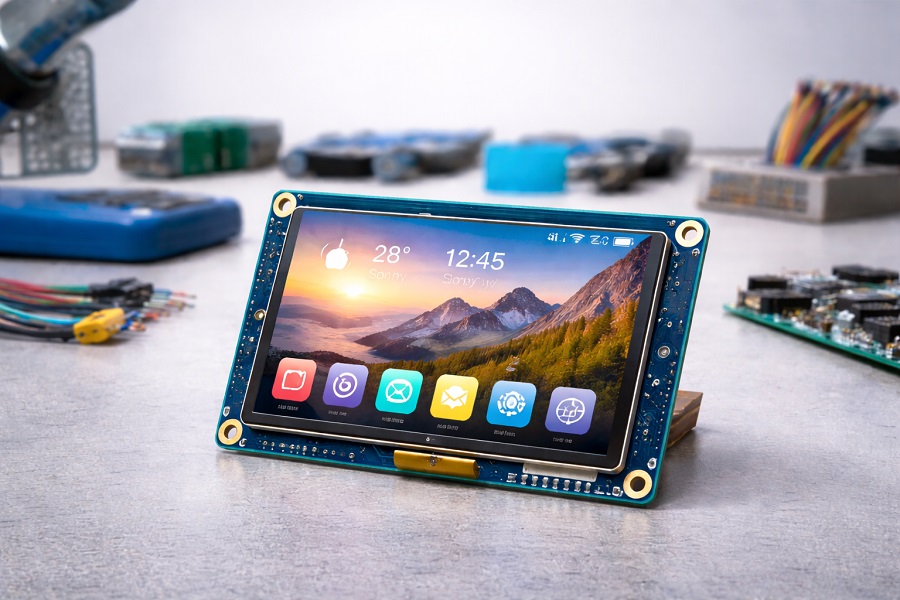
Thin-Film Transistor (TFT) LCD displays use a backlight combined with a transistor-controlled liquid crystal layer to produce images. Each pixel is regulated by a transistor, enabling stable brightness, consistent colour reproduction, and long operating life.
TFT LCDs are widely used in industrial environments because they support:
- High brightness levels
- Wide operating temperature ranges
- Long-term, continuous operation
They are also compatible with industrial enhancements such as optical bonding, anti-reflective coatings, rugged touch interfaces, and environmental sealing.
OLED Displays
Organic Light-Emitting Diode (OLED) displays generate light at the pixel level. Each pixel emits its own light, eliminating the need for a backlight. This enables extremely high contrast ratios, deep blacks, and wide viewing angles.
OLED technology is often selected for compact or visually focused devices. However, its organic materials respond differently to heat, UV exposure, and static content than LCD-based technologies.
Brightness and Sunlight Readability
Sunlight readability is often the defining requirement for outdoor and semi-outdoor equipment.
TFT LCD displays can achieve brightness levels of 1,000 to 2,500 nits, making them well-suited for direct sunlight. When combined with transflective layers, optical bonding, and anti-glare coatings, they maintain clarity in high ambient light.
OLED displays, while visually striking indoors, typically operate at lower brightness levels. Under direct sunlight, they can experience glare, reduced contrast, and image washout, limiting their effectiveness in outdoor environments.
Durability and Environmental Resistance
Industrial applications often expose displays to vibration, shock, humidity, dust, and temperature extremes.
TFT LCD displays use inorganic materials that remain stable under prolonged environmental stress. They are commonly specified for:
- Rugged handheld equipment
- Medical monitors
- Outdoor kiosks
- Industrial control panels
OLED displays are thinner and lighter, but their organic layers are more sensitive to moisture ingress, temperature fluctuations, and long-term UV exposure. This can limit their reliability in demanding environments.
Power Consumption and Efficiency
Power efficiency depends heavily on usage patterns.
TFT LCD displays rely on backlighting, which increases baseline power consumption. However, modern LED backlights, adaptive brightness controls, and efficient power management have significantly narrowed the gap in industrial use cases.
OLED displays consume less power when displaying darker content because only active pixels draw energy. This can be beneficial in battery-powered devices with dynamic visual content.
Customization and Integration Flexibility
TFT LCD displays offer extensive customization options, including:
- High-brightness configurations
- Transflective or sunlight-readable panels
- Ruggedized touchscreens
- EMI shielding
- Custom sizes and aspect ratios
These options make TFT LCDs adaptable to a wide range of industrial designs.
OLED displays offer flexibility in thin and lightweight form factors, but ruggedization and environmental customization options are more limited.
Summary Comparison
| Criteria | TFT LCD | OLED |
| Sunlight readability | Strong | Limited |
| Environmental durability | High | Moderate |
| Burn-in resistance | Excellent | Limited |
| Customization options | Extensive | Limited |
Matching Display Technology to Operating Conditions
No single display technology fits every application. TFT LCD displays offer proven durability, long-term reliability, and superior sunlight readability for industrial and outdoor environments. OLED displays deliver exceptional contrast and visual performance where environmental stress is minimal.
Evaluating operational conditions, environmental exposure, content type, and lifecycle expectations ensures the selected display technology aligns with real-world performance requirements.