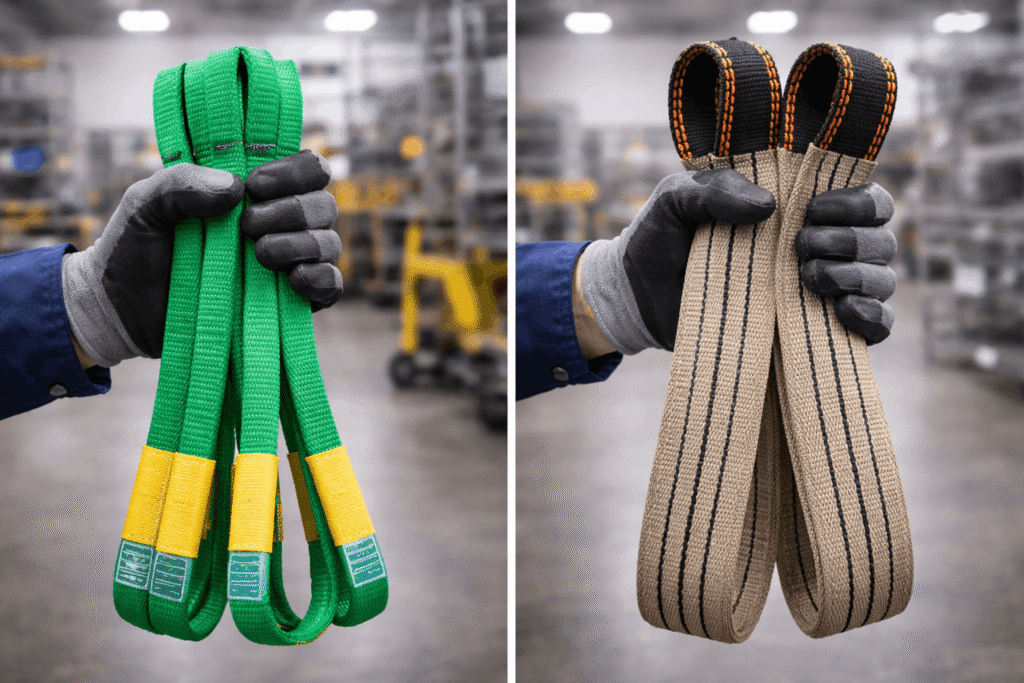

Selecting the right lifting strap plays a direct role in load control, equipment longevity, and jobsite safety. While nylon slings and heavy-duty lifting straps are often used interchangeably, they behave differently under load, in environmental conditions, and with repeated use. Understanding these differences helps industrial teams match the strap to the lift rather than forcing one solution into every application.
At Murphy Industrial Products, Inc., we supply a wide range of industrial lifting straps that perform reliably in industrial environments. This guide breaks down how nylon lifting slings compare with lifting straps and when each option delivers better results.
Why Strap Selection Matters?
Lifting straps do more than connect a load to a hoist. They absorb shock, distribute weight, and protect both equipment and materials during movement. Using the wrong strap can introduce excessive stretch, surface damage, or premature wear. Over time, these issues increase inspection failures, downtime, and replacement costs.
Nylon and heavy-duty lifting straps are both widely used, but they are designed for different performance priorities.
Strength and Stretch Comparison
Nylon lifting straps are known for their elasticity. Nylon fibers stretch under load, which allows the strap to absorb shock during lifting and sudden load shifts. This characteristic makes nylon lifting slings useful in applications where dynamic forces are present or where smooth load control is required.
Heavy-duty lifting straps, which may be constructed from polyester or reinforced synthetic blends, generally stretch less than nylon. Reduced elongation helps maintain precise load positioning and minimizes movement during lifting. For operations where alignment and control are critical, lower stretch can be an advantage.
Neither option is inherently stronger than the other. Strength is determined by the Working Load Limit (WLL), which varies by strap width, construction, and configuration. The key difference lies in how each material behaves under tension.
Resistance to Abrasion and Moisture
Environmental exposure plays a significant role in strap performance.
Nylon lifting slings handle abrasion reasonably well, but are more sensitive to moisture. Nylon absorbs water, which can temporarily reduce strength and increase weight. In wet environments or outdoor operations, this characteristic requires closer inspection and drying before storage.
Heavy-duty lifting straps made from polyester-based materials resist moisture absorption. They maintain consistent strength when exposed to rain or humidity and are less prone to mildew. Polyester fibers also resist UV degradation better than nylon, making them suitable for outdoor or long-term use.
In environments where moisture, chemicals, or sunlight are constant factors, heavy-duty lifting straps often provide longer service life.
Working Load Limit and Inspection Considerations
Both nylon lifting straps and heavy-duty lifting straps must be selected and used according to their rated WLL. Tags should always be legible, showing capacity, configuration, and material type.
Inspection practices are similar for both options. Operators should check for cuts, fraying, abrasion, chemical damage, and heat exposure before each use. Nylon straps may show glazing or stiffness after heat exposure, while heavy-duty lifting straps may display surface wear or broken fibers.
Any strap showing damage that affects load-bearing fibers should be removed from service immediately. Consistent inspection protects both personnel and lifted materials.
Ideal Applications for Each Option
Nylon lifting slings perform well in applications that benefit from shock absorption, such as machinery placement, maintenance lifts, or controlled positioning tasks. Their flexibility also makes them easier to wrap around irregular shapes.
Heavy-duty lifting straps are better suited for repetitive lifts, outdoor handling, and environments where moisture resistance and dimensional stability are essential. They are commonly used in manufacturing, fabrication, and material handling operations where consistent performance is required.
Many facilities keep both options available, selecting the strap that best matches each lift.
Conclusion – The Right Sling Depends on the Lift
There is no universal answer when comparing nylon lifting slings and heavy-duty lifting straps. Nylon provides elasticity and shock absorption, while heavy-duty lifting straps offer stability and environmental resistance. The right choice depends on load behavior, exposure conditions, and handling frequency.
Matching industrial lifting straps to the specific demands of each lift improves safety, extends equipment life, and supports consistent jobsite performance.