
Production environments continue to demand greater efficiency, precision, and flexibility across packaging, assembly, and material-handling processes. A flat belt conveyor remains one of the most widely used systems due to its simplicity and ability to handle a broad range of products with consistent movement.
At the same time, evolving production requirements have introduced more specialized solutions such as the retractable conveyor, designed to improve flexibility and support complex workflows. Selecting the right system depends on understanding how each option aligns with operational needs and long-term performance goals.
Flat Belt Conveyor vs Retractable Conveyor: Core Functional Differences
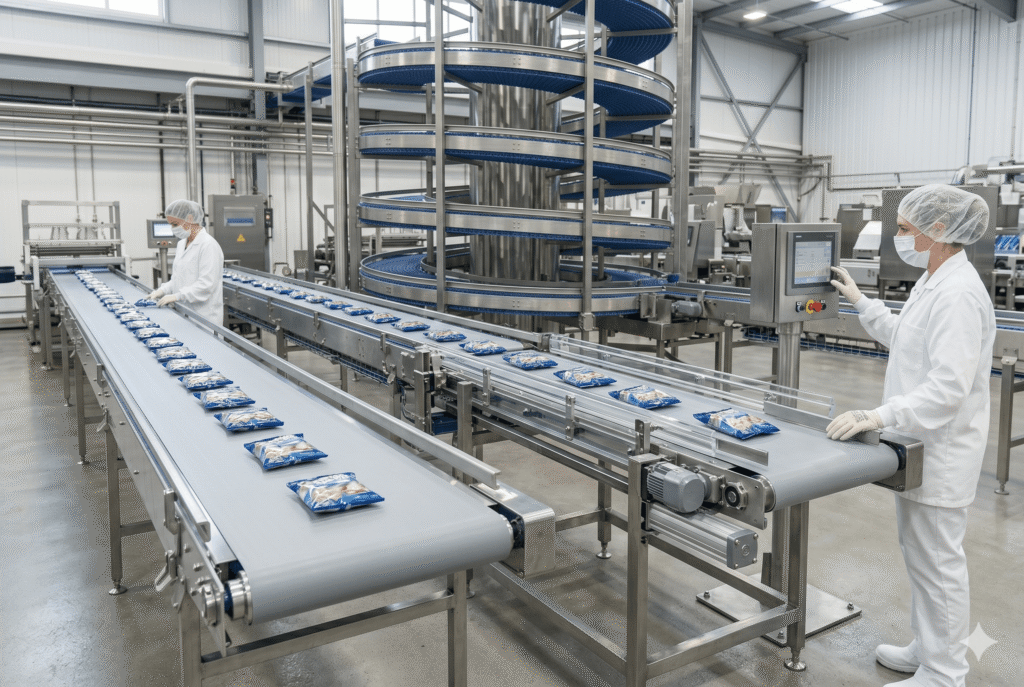
A flat belt conveyor uses a continuous belt to transport products along a steady, linear path. It is ideal for uniform product handling, offering smooth movement and consistent speed across production lines.
A retractable conveyor, on the other hand, includes a moving or extendable section that can retract or adjust position during operation. This feature allows products to be redirected, spaced, or transferred between lines without interrupting workflow. The added flexibility makes retractable systems suitable for dynamic production environments where product flow varies.
Application Suitability in Modern Production Lines
Flat belt conveyors are commonly used in applications where products require stable transport over fixed distances. Industries such as food processing, packaging, and manufacturing rely on these systems for consistent throughput and minimal complexity.
Retractable conveyors are better suited for operations that require product diversion, multi-lane distribution, or intermittent flow. They are often integrated into automated systems that require flexibility to manage changing production conditions.
The choice between the two depends on whether the production line prioritizes simplicity or adaptability.
Impact on Throughput, Flexibility, and Workflow Optimization
Flat belt conveyors support high throughput by maintaining continuous movement with minimal interruptions. Their straightforward design ensures consistent product flow, which is beneficial for high-volume operations.
Retractable conveyors provide greater flexibility by enabling controlled product transfer and spacing. This helps optimize workflows in systems where products must be routed across multiple processing stages. While they may introduce additional mechanical complexity, they can significantly improve line efficiency in advanced setups.
Balancing throughput and flexibility is key when evaluating these systems.
Maintenance, Reliability, and Operational Considerations
Flat belt conveyors are known for their reliability and relatively simple maintenance requirements. Fewer moving components reduce the likelihood of mechanical failure and simplify servicing.
Retractable conveyors require more detailed maintenance due to their additional moving parts and control mechanisms. Proper maintenance planning is essential to ensure consistent performance and avoid downtime.
Working with experienced system integrators helps ensure that both conveyor types are designed for durability and ease of maintenance.
Cost, Integration, and Long-Term Value
Flat belt conveyors typically involve lower initial costs and faster implementation. Their straightforward design makes them easier to integrate into existing production lines.
Retractable conveyors may require a higher initial investment due to their advanced functionality and integration requirements. However, they can deliver long-term value by improving operational flexibility and reducing bottlenecks.
Evaluating the total cost of ownership rather than the initial cost alone provides a clearer understanding of long-term benefits.
Which Conveyor System Is Better for Your Production Line Needs?
The decision between a flat belt conveyor and a retractable conveyor depends on production priorities. Flat belt systems offer reliability, simplicity, and consistent throughput, while retractable conveyors provide flexibility and improved workflow control in complex operations.
Conovey delivers engineered conveyor solutions designed to align with modern production requirements. From system integration to custom configurations, solutions are built to support efficiency, scalability, and long-term performance. Facilities evaluating belt conveyors and retractable systems can benefit from a strategic approach that considers both immediate needs and future expansion.
Connect with Conovey today to implement conveyor systems that deliver reliable performance and operational control.