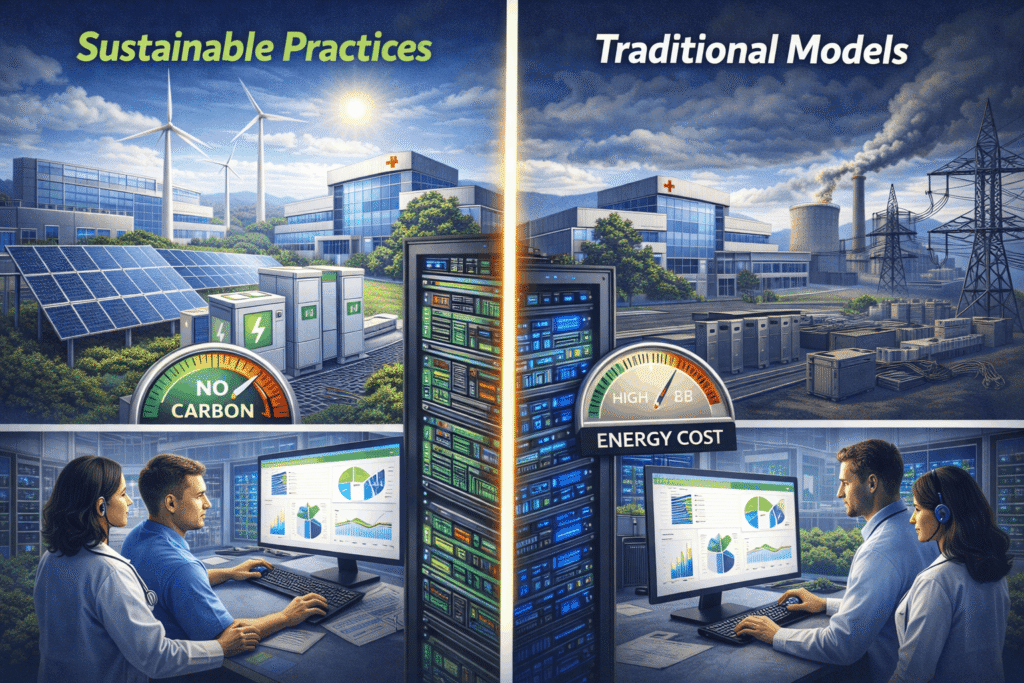

Healthcare organizations rely on digital systems to support patient care, diagnostics, and operational continuity. Clinical data volumes continue to rise as imaging systems, AI tools, and connected medical devices expand across care environments. This growth forces decision-makers to evaluate how a healthcare data center supports reliability, compliance, and long-term scalability.
Energy stability, deployment speed, and cost predictability now influence infrastructure decisions as much as capacity. These factors separate sustainable healthcare data centers from traditional models.
What Characterizes a Traditional Healthcare Data Center?
Traditional healthcare data centers depend on centralized facilities powered primarily by regional electrical grids. These environments require long development cycles, extensive permitting, and significant upfront capital investment.
A conventional Healthcare data center often uses fixed infrastructure that limits flexibility. Scaling capacity typically involves major construction, extended timelines, and increased operational risk. Power costs fluctuate based on grid demand, pricing volatility, and regional congestion.
For healthcare providers, these constraints affect uptime reliability and cost control. As data workloads increase, traditional models struggle to adapt without disruptive upgrades.
How Do Sustainable Healthcare Data Centers Operate Differently?
A sustainable data center for healthcare integrates renewable energy, modular infrastructure, and distributed deployment strategies. Instead of relying fully on centralized grid power, these facilities pair compute capacity with on-site energy systems.
Solar generation and battery storage provide consistent power for long-running workloads. Modular design allows healthcare organizations to deploy capacity closer to hospitals, research centers, and care networks. This approach improves latency, enhances redundancy, and reduces dependence on external power conditions.
Sustainable models align infrastructure growth with clinical demand rather than fixed facility limits.
How Do Sustainable and Traditional Healthcare Data Centers Compare?
| Comparison Area | Traditional Healthcare Data Center | Sustainable Healthcare Data Center |
| Energy Source | Centralized grid electricity | Solar power with battery-backed resilience |
| Deployment Timeline | Multi-year planning and construction | Modular deployments are operational in months |
| Cost Stability | Exposed to grid price volatility | Predictable long-term energy costs |
| Scalability | Requires major infrastructure upgrades | Capacity expands through modular additions |
| Reliability | Vulnerable to grid outages | Designed for resilient, continuous operations |
| Latency | Often centralized and distant | Distributed placement closer to care facilities |
Why Does Energy Stability Matter for Healthcare Operations?
Healthcare systems cannot tolerate prolonged downtime. Clinical applications, patient records, and diagnostic platforms require uninterrupted access. Grid disruptions or regional power stress events place traditional facilities at risk.
A data center for healthcare powered by renewable energy and storage systems maintains consistent performance during extended operations. Energy stability supports long-duration workloads such as imaging analysis, AI-assisted diagnostics, and data replication.
This reliability protects patient care workflows and reduces operational risk across healthcare networks.
How Does Decentralization Improve Healthcare Data Performance?
Decentralized data center models place compute resources closer to healthcare facilities. This structure reduces latency and improves response times for real-time applications.
A distributed Healthcare data center supports faster access to patient data, imaging results, and analytics platforms. It also improves redundancy by allowing workloads to shift between locations during localized disruptions.
Decentralization strengthens performance while reducing dependency on single centralized facilities.
How Do Sustainable Models Support Compliance and Security?
Healthcare data environments must meet strict regulatory requirements for privacy, availability, and physical security. Sustainable healthcare data centers incorporate controlled access, monitoring systems, and secure infrastructure design.
Energy independence strengthens compliance by reducing outage-related risks. A Sustainable data center for healthcare supports continuous availability during emergencies, grid failures, or regional disruptions. This consistency aligns with healthcare regulatory expectations while maintaining performance.
Why Are Healthcare Organizations Reassessing Infrastructure Strategies?
Rising data volumes, energy constraints, and cost pressure push healthcare organizations to reconsider traditional infrastructure models. Long build cycles and grid dependency limit flexibility as clinical systems evolve.
Sustainable practices offer a scalable alternative that balances reliability, performance, and environmental responsibility. Choosing the right Healthcare data center model now plays a direct role in long-term operational resilience.
How Does Flux Core Data Systems Support Modern Healthcare Infrastructure?
Flux Core Data Systems is a veteran- and minority-owned company bridging renewable energy and digital infrastructure. The company deploys modular, solar- and battery-powered distributed data centers that operate entirely on resilient energy.
These facilities become fully operational in as little as 90 days and provide a faster, more sustainable alternative to traditional hyperscale data centers. Flux Core serves enterprises, AI developers, and cloud providers with secure, low-latency, decentralized computing.
Through Compute Purchase Agreements, Flux Core delivers compliant, on-demand compute services while partnering with investors and landowners to develop revenue-generating infrastructure.
Learn how Flux Core Data Systems enables resilient, renewable-powered healthcare data centers built for scalability, reliability, and long-term performance.