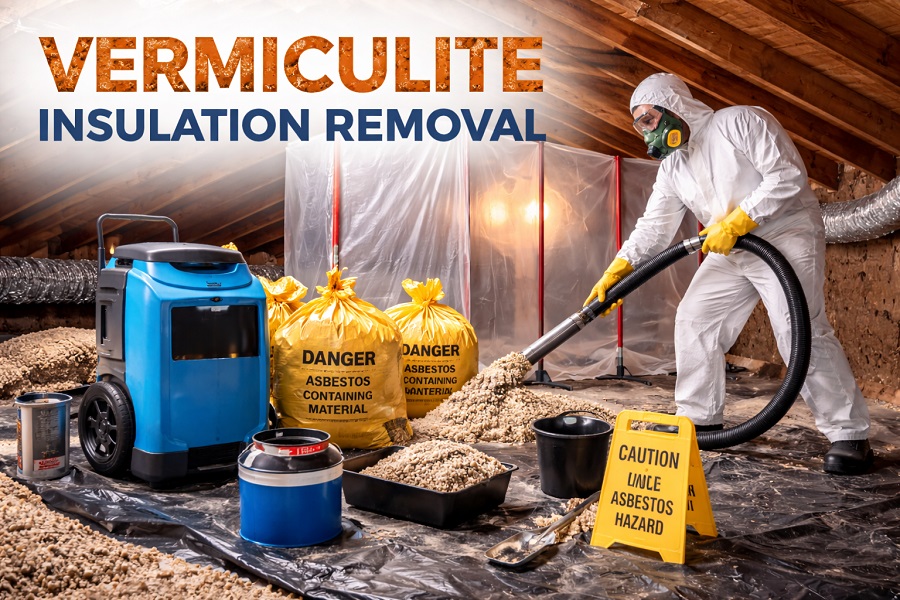

Many Canadian homes built decades ago still contain insulation materials that raise questions during renovations or maintenance planning. Vermiculite and Zonolite insulation often come up in these situations, leaving homeowners unsure which to use.
The lack of Zonolite and vermiculite insulation removal creates an unwelcome uncertainty. This uncertainty matters because both materials can carry asbestos-related risks depending on their source and condition. Without clarity, homeowners may face delayed projects, unexpected costs, or safety concerns.
Air Doctors provides residential sampling services by collecting insulation samples for laboratory analysis. Accredited laboratories complete the testing, helping homeowners understand what is present before decisions are made.
What Is Vermiculite Insulation?
Vermiculite insulation is a loose-fill material commonly found in Canadian homes built between the 1920s and the 1980s. It appears as lightweight, pebble-like granules and was widely used for its fire resistance and insulating properties.
Key characteristics include:
- Brown, gold, or grey granular appearance
- Lightweight and loose, often found in attics
- Poured between joists rather than rolled or batched
Vermiculite itself is a naturally occurring mineral. The concern does not come from the material alone, but from where and how it was sourced. This sourcing history is why vermiculite insulation removal may be necessary in older Canadian homes.
What Is Zonolite Insulation?
Zonolite is a brand name of vermiculite insulation. It was one of the most widely distributed vermiculite products used in Canadian homes.
Important points about Zonolite:
- Manufactured primarily during the mid-20th century
- Sourced from a specific mine known to contain asbestos
- Commonly referenced in government advisories and homeowner reports
Not all vermiculite is Zonolite, but all Zonolite is vermiculite.
Vermiculite vs. Zonolite: Key Differences Explained
The main distinction lies in origin and branding, not appearance.
Vermiculite insulation
- Describes the insulation material type
- Can come from multiple sources
- May or may not contain asbestos
Zonolite insulation
- Refers to a specific branded product
- Known association with asbestos contamination
- Higher likelihood of requiring professional assessment
Visually, these materials look nearly identical, making confirmation through laboratory analysis essential.
Why Asbestos Is a Concern With These Insulations
Some vermiculite insulation sources were contaminated with asbestos during mining. Asbestos fibres are microscopic and cannot be seen during visual inspections.
Concerns arise when:
- Insulation is disturbed during renovations
- Air movement spreads fibres into living areas
- Long-term exposure risks increase
Asbestos remains harmless when undisturbed, but activities involving insulation often require professional sampling and lab testing.
How Vermiculite and Zonolite Are Identified in Canadian Homes
Identification begins with professional sampling rather than assumptions.
A typical process includes:
- Visual vermiculite inspection and assessment of attic insulation
- Controlled collection of small material samples
- Submission to an accredited laboratory for analysis
Air Doctors completes the sampling process. Independent laboratories perform the testing and confirm whether asbestos is present. This separation ensures accurate results and avoids conflicts of interest.
Removal vs. Management: What Happens After Testing
Laboratory results guide next steps. Outcomes usually fall into one of two categories.
Management options may include:
- Leaving insulation undisturbed
- Sealing attic access points
- Monitoring insulation condition over time
Removal may be considered when:
- Renovation work will disturb the insulation
- Insulation condition is deteriorating
- Lab results indicate higher asbestos content
Each situation is evaluated based on risk, household plans, and property conditions. No single approach fits all homes.
Why This Distinction Matters for Canadian Homeowners
Understanding the difference between vermiculite and Zonolite insulation helps homeowners make informed decisions without unnecessary alarm.
Clear identification:
- Prevents renovation delays
- Reduces uncertainty during property transactions
- Supports long-term planning for residential spaces
Homes across Scarborough, Markham, Newmarket, Cobourg, Sunderland, Beaverton, and Woodbine often contain these materials due to construction timelines. Professional sampling and laboratory testing provide clarity before taking any action.
Confirming insulation type requires proper sampling and accredited laboratory analysis. Air Doctors assists homeowners by collecting samples safely and coordinating testing through accredited laboratories.
For homeowners planning renovations or seeking clarity, scheduling a professional assessment helps support confident, informed decisions. Contact Air Doctors to schedule a vermiculite removal or assessment to better understand the next steps for a residential property.