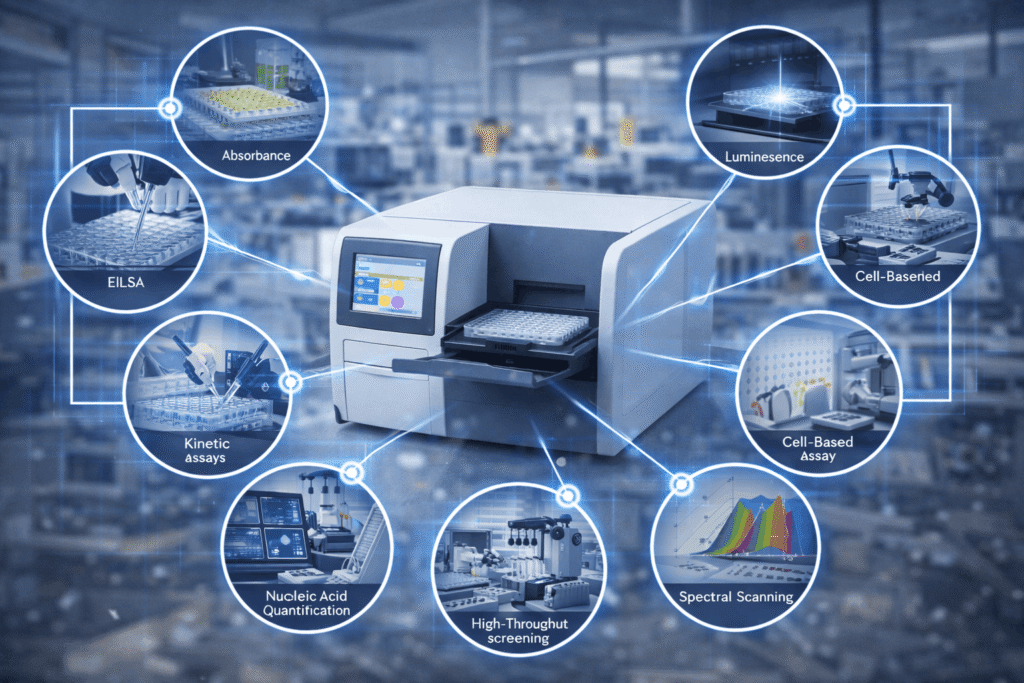

Multi-assay laboratories operate in an environment where detection requirements shift frequently. One study may rely on fluorescence, another on luminescence, while absorbance measurements remain part of routine workflows. A multimode microplate reader accommodates this variability by enabling multiple assay types to run on a single platform, reducing the need for frequent instrument changes.
As sample volumes increase and turnaround expectations tighten, efficiency becomes just as critical as flexibility. Managing several single-mode readers can introduce scheduling conflicts, data variability, and operational overhead. A unified reading platform helps streamline workflows, maintain assay consistency, and support scalable research without adding unnecessary complexity.
What Is a Multimode Microplate Reader?
A multimode microplate reader is a single instrument capable of performing multiple detection methods, such as absorbance, fluorescence intensity, luminescence, and time-resolved measurements. It allows labs to run diverse assays on one platform rather than switching between specialized systems.
1. Supports Multiple Assay Types on a Single Platform
Multi-assay labs benefit from running ELISA, cell-based assays, enzyme kinetics, and reporter assays on one system, reducing setup changes and scheduling conflicts.
2. Reduces Instrument Footprint and Lab Clutter
Replacing multiple single-mode readers with one multimode system frees up valuable bench space and simplifies instrument management.
3. Improves Workflow Efficiency Across Assays
Centralizing detection shortens handoffs between assays and instruments, enabling smoother scheduling and faster experiment turnaround.
4. Enhances Data Consistency and Reproducibility
Using a single reader for multiple assays reduces variability introduced by instrument switching, resulting in more consistent data across projects.
5. Enables Faster Assay Development and Method Optimization
Researchers can evaluate different detection modes during development without moving samples between systems, accelerating method refinement.
6. Scales Easily with Changing Research Demands
As assay requirements evolve, multimode systems adapt without requiring additional readers or major workflow redesigns.
7. Integrates Seamlessly with Automated Lab Workflows
Modern automated microplate readers are designed for robotic compatibility, making them well-suited for integrated screening and high-throughput environments.
8. Improves Throughput Without Increasing Labor
Automation-ready designs allow labs to process more plates per day without adding staff or extending operating hours.
9. Delivers Better ROI Than Single-Mode Readers
While the upfront investment may be higher, multimode readers replace multiple instruments, reducing long-term equipment and maintenance costs.
10. Future-Proofs the Lab for Emerging Assay Technologies
As new assay formats and detection techniques emerge, multimode platforms provide the flexibility to adopt them without starting over.
When a Multimode Microplate Reader Becomes Essential
Multimode readers become essential when labs manage diverse assays, expand screening programs, or integrate automation while maintaining data consistency.
Key Considerations When Choosing a Multimode Microplate Reader
Labs should evaluate detection range, automation compatibility, software flexibility, throughput requirements, and long-term support before selecting a system.
A Core Instrument for Multi-Assay Success
For labs running multiple assay types, flexibility and consistency are non-negotiable. A well-selected multimodal platform reduces complexity while supporting growth and automation. Copia Scientific helps laboratories identify reliable, integration-ready solutions that fit real-world workflows.
Contact Copia Scientific to discuss a multimode microplate reader that aligns with your assay portfolio and long-term research goals.