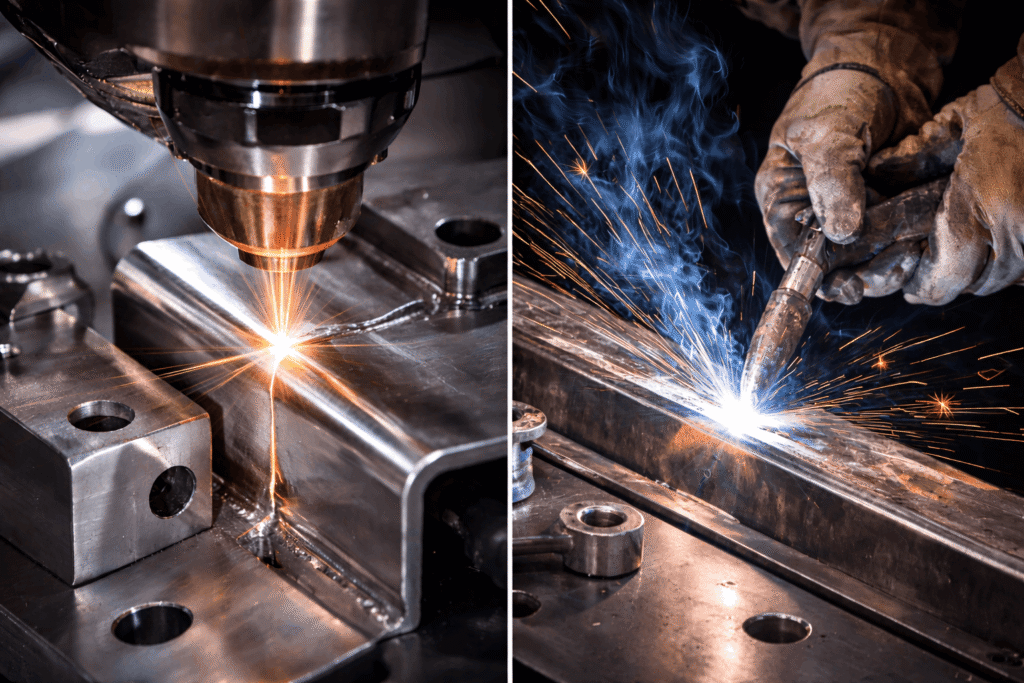

Modern manufacturing requires a precise balance between accuracy, repeatability, and production speed. Welding shops today must deliver consistent joint quality while adapting to tighter tolerances and increasingly complex fabrication requirements. This has led many manufacturers to compare precision laser welding with conventional welding techniques, such as MIG and TIG, to determine which method best meets modern fabrication standards.
While traditional welding processes remain widely used, precision laser welding is reshaping expectations around quality, efficiency, and long-term performance in high-demand industrial environments.
Understanding Precision Laser Welding vs Conventional Welding Methods
Precision laser welding uses a highly focused laser beam to fuse metals at a specific point with controlled heat input. The process produces deep, narrow welds while minimizing heat spread to surrounding material.
In contrast, conventional welding techniques such as MIG and TIG rely on electric arcs to generate heat. These methods introduce broader heat-affected zones, which can increase distortion and require more post-weld finishing—particularly on thin or intricate components.
Accuracy and Weld Quality Comparison
Precision is a defining factor in welding performance.
- Laser welding delivers consistent penetration and alignment due to its tightly controlled energy source. This makes it suitable for applications requiring exact tolerances and repeatable results.
- MIG and TIG welding depend more heavily on operator skill, increasing variability across parts and production runs.
For industries where dimensional accuracy directly affects product performance, laser welding offers a clear advantage in weld consistency and quality control.
Heat Input and Material Distortion
One of the most significant differences between these methods lies in thermal impact.
- Precision laser welding introduces minimal heat into the workpiece, reducing warping and preserving material properties.
- Traditional welding methods generate wider heat-affected zones, which can lead to distortion, residual stress, and additional straightening or corrective work.
This comparison becomes especially important when working with thin-gauge metals, stainless steel, or heat-sensitive alloys.
Production Speed and Throughput
From a productivity standpoint, the contrast is notable.
- Laser welding systems operate at higher speeds and require less post-weld cleanup, reducing total cycle time.
- Conventional welding typically entails lower travel speeds, greater spatter, and additional grinding or finishing.
For high-volume manufacturing environments, the faster processing rates of laser welding directly support improved throughput and scheduling efficiency.
Automation and Integration Capabilities
Automation plays an increasingly central role in modern fabrication.
- Precision laser welding integrates seamlessly with robotic systems, CNC controls, and automated production lines, ensuring uniform welds across large batches.
- MIG and TIG welding can be automated, but often require more complex programming and supervision to maintain consistency.
This makes laser welding particularly well-suited to data-driven, Industry 4.0 fabrication environments.
Application Flexibility Across Industries
Both approaches serve important roles, but their applications differ.
- Laser welding is commonly used for medical devices, automotive components, electronic housings, and precision assemblies requiring clean aesthetics and tight tolerances.
- Conventional welding remains effective for structural fabrication, heavy-gauge materials, and projects where surface finish and micro-precision are less critical.
Choosing between the two often depends on component complexity, material thickness, and quality expectations.
Long-Term Efficiency and Sustainability
Energy efficiency and material optimization are growing priorities.
- Precision laser welding supports sustainable manufacturing through lower energy consumption per weld, reduced material waste, and minimal rework.
- Traditional welding methods typically consume more energy and materials due to extended weld times and finishing requirements.
Over time, these differences can significantly impact operational costs and environmental performance.
Evaluating the Right Welding Approach for Modern Fabrication
When comparing precision laser welding vs conventional welding techniques, the distinction becomes clear. Laser welding excels in accuracy, speed, automation readiness, and finish quality, making it well-suited for modern, high-precision fabrication environments. Traditional welding methods continue to play a role in heavy-duty and structural applications, but may require trade-offs in efficiency and repeatability.
As fabrication demands continue to evolve, understanding these differences allows welding shops to align their processes with performance, quality, and production goals—ensuring the right welding method is used for the right application.