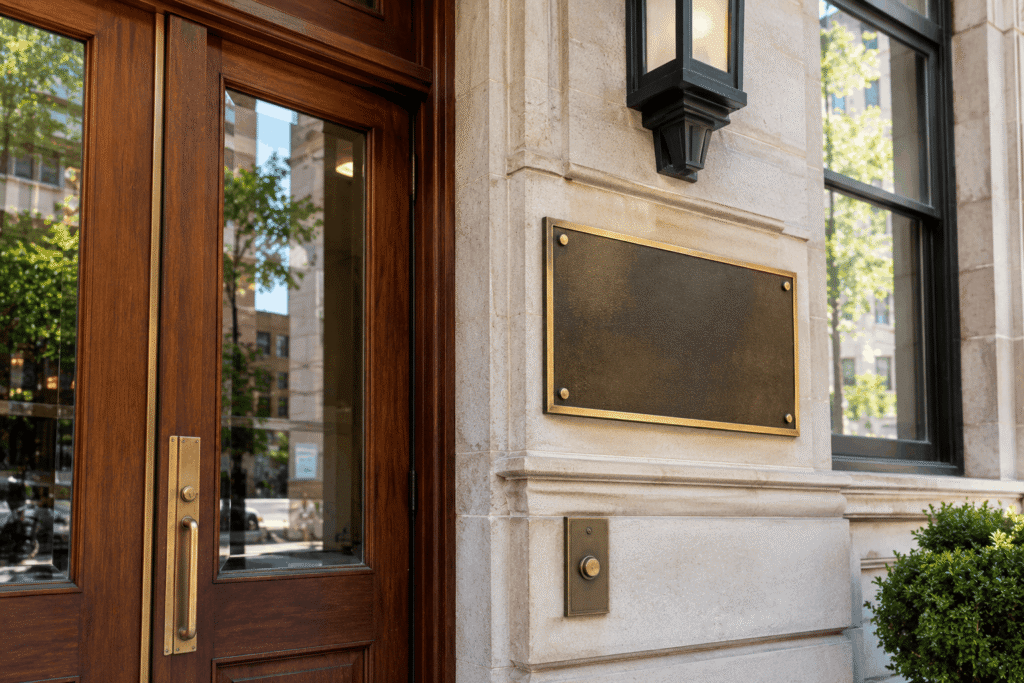

Fitting out an entire floor is simple. Replacing a single plate on a corridor of 30 is an altogether more involved task. The replacement plate has to work alongside the other 29, which have no record on file and no supplier record, just fifteen years of fingerprints and sun exposure.
To match existing door signage, study the details of the plate it replaces: the material, lettering style, font, and size. These elements help custom door nameplates blend seamlessly with their predecessors.
People Also Ask
Is matching an old door nameplate possible without the artwork?
Yes, a photo (with clearly visible text), the dimensions, and ideally the plate itself can give a manufacturer enough information to match the material, font, and overall layout.
How do I tell if a nameplate is engraved, etched or printed?
Using a fingernail to trace across the text on the plate. Engraved and etched lettering sinks below the surface, while printed text stays on the surface. Anodized text will feel completely flat.
Who makes custom door nameplates in Toronto?
Identifab Industries, a manufacturer of custom nameplates at 43 Baywood Road in Etobicoke, has manufactured nameplates since 1969.
Why A Partial Refresh Is Harder Than A Full One
A full refresh establishes its own standard. A partial one adopts someone else’s.
Every choice made years ago by whoever has since become a fixed target: the font, the direction of the brushed grain, the spacing between the name and the title. Miss any of these, and the new plate screams out from across the corridor.
Identify What Is Already On The Door
Start with the material. Brass shows a warm yellow tone. Aluminum feels lighter than it looks. Lamicoid shows a different color along its cut edge.
Then work out the method. Engraved or etched letters dip below the surface, and screen-printed letters sit slightly raised. Anodized text feels perfectly flat, as if the letters live inside the metal.
Matching Fonts, Finishes And Color
Photograph the plate straight on, beside a ruler. From a clear picture, a manufacturer finds the nearest font, cap height, and letter spacing. Letter spacing reveals a mismatch as often as the font itself.
On brushed metal, observe the grain direction. A plate brushed vertically does not harmonize with horizontal neighbours.
Matching anodized color is the most difficult. The sun and cleaning leave old colors after years of exposure, so a new plate in the original shade could appear brighter. To date, a perfect match on a 20-year-old color does not exist. Strive to match at corridor distance and hold a sample against the door before you approve the order.
Sizes, Corner Radii And Fixing Centres
Measure widths, heights, and thicknesses in millimetres. Many plates in Canadian offices are in imperial sizes such as 2 by 8 inches, so remember to record both measurements in different systems.
Note the shape of the plate’s corners, whether square, slightly rounded, or fully rounded. Most importantly, you have to measure the fixing centres, the distance between the holes for screws, as replacement door nameplates with the same fixing centres can simply be placed on the old holes on the existing screws.
A door nameplate with the same fixing centres can be mounted on existing screws without patching the place where the old one was.
Discontinued Holder And Insert Systems
Holders often outlive the companies behind them. When a system goes out of production, you have two choices. Order custom inserts cut to the old channel’s inside dimensions, or replace the holders across the floor.
Holders often outlive the companies which make them. When systems are taken out of production, you have two options. You can either buy custom inserts cut to the inside dimensions of the old channels, or you can replace the whole system on the floor.
Take an old insert out of a channel and hand it to the manufacturer. A physical piece of plastic will tell the manufacturer more than a drawing ever could.
Pull one old insert out and send it with your measurements. A physical insert tells a manufacturer more than any drawing.
What You Find On Doors In Older Toronto Office Buildings
Door nameplates in Toronto office towers can span multiple generations. One floor might have engraved lamicoid from one fit-out, aluminum holders from the next and brass plates on the corner offices. Treat each generation as its own matching job.
Landlord And Base Building Signage Standards
Many commercial landlords publish tenant signage standards for their buildings. Ask your property manager for the base building standard before ordering. It will often dictate size, finish, font, and mounting height and answer half your matching questions in one document. Writing your own standard is the surest way of keeping door nameplates consistent across buildings.
When To Match And When To Replace The Whole Floor
Match when only a few plates need replacing, and the originals still look good. Replace the floor when:
- three generations of plates already clash
- the holder system is out of production
- a rebrand is less than a year away
Past a certain point, copying old inconsistencies costs more than starting clean.
What To Send Us Before You Inquire
- A straight-on photo of the plate beside a ruler.
- Width, height, thickness and corner style.
- Fixing centres, or a note if the plate uses tape.
- One old insert, if the door uses a holder.
- The landlord’s signage standard, if one exists.
Read The Old Plate Before You Order Custom Door Nameplates
Identify the materials, methods, fonts, finishes, and fixing centres; check the tenant’s standard, and send a photo with measurements. Match the small gaps, and update the floors if the generations clash.
One wrong plate draws attention to every other door in the corridor. A ten-minute ruler and camera survey can fix that.
Identifab has produced custom door nameplates in Toronto from its Etobicoke facility since 1969, including plates matched to existing wall signage. Email your photos to info@identifab.com or call (416) 743-7343 to start matching.
