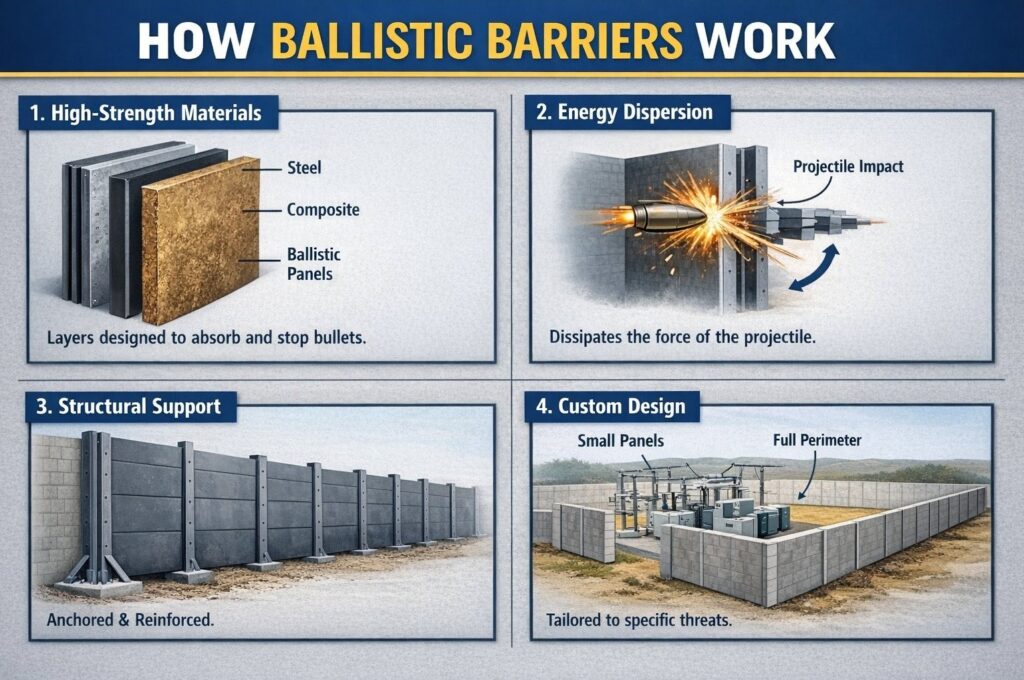

In a world where energy facilities, defense sites, and critical infrastructure face rising security threats, protection systems must do more than resist fire—they must stop high-velocity impacts and contain explosions. That’s why organizations are increasingly investing in ballistic barriers. These systems combine strength, precision engineering, and advanced materials to shield vital assets from both internal and external threats.
What Makes Ballistic Barriers Different from Standard Walls
Unlike traditional walls, which are designed mainly for structural or fire resistance, ballistic barriers are engineered to absorb and disperse the kinetic energy of bullets, shrapnel, and debris. Each layer serves a specific function—stopping penetration, spreading impact, and preventing fragmentation.
Their distinct characteristics include:
- High-density materials such as steel, fiberglass composites, and ceramic panels.
- Multi-layer construction for energy absorption and minimal ricochet.
- Certified protection ratings that align with standards like UL 752 or NIJ levels.
This engineering precision ensures that facilities can remain operational even when exposed to severe impact or hostile activity.
Overview of Ballistic Barrier Products and Performance Levels
A wide range of ballistic barrier products is available today to meet different protection requirements. These systems are classified by their ability to resist varying calibers and velocities of ammunition.
Common configurations include:
- Modular panels for quick installation in existing buildings.
- Permanent walls are integrated into control rooms, command centers, and guard posts.
- Portable shields are used in temporary or field-deployed operations.
Performance is measured through standardized testing that verifies penetration resistance, spall control, and structural stability under repeated impact. This ensures that ballistic barrier products perform consistently in both industrial and defense applications.
Integrating Blast Ballistic Enclosures in High-Security Environments
In facilities where explosive and ballistic threats coexist, blast ballistic enclosures offer dual protection. These enclosures combine blast-rated design with ballistic-resistant materials, creating a structure that can withstand both overpressure and projectile impact.
Applications include:
- Energy and chemical facilities with high-risk storage zones.
- Defense and research installations requiring secure operational areas.
- Critical control hubs where personnel safety and continuity are of paramount importance.
By integrating blast ballistic enclosures early in the design process, facilities achieve a layered protection strategy that addresses multiple hazards without compromising accessibility or operational efficiency.
The Role of Ballistic Walls in Minimizing Impact Damage
When threats occur, the difference between a controlled event and catastrophic damage often depends on structural containment. Ballistic walls play a crucial role in mitigating impact by absorbing the force of bullets or debris before they can compromise essential systems.
They not only protect personnel but also limit the spread of damage to surrounding areas—an especially critical factor in industrial environments housing sensitive machinery, chemical storage, or electrical equipment. In defense contexts, ballistic walls ensure command and response centers remain functional during active threats, supporting real-time decision-making.
Conclusion – Why Layered Protection Is Now an Industry Standard
The modern approach to safety involves more than one barrier—it’s about building multiple layers of defense. Ballistic barriers and blast ballistic enclosures represent the evolution of protective engineering, designed to handle complex threats that combine impact, fire, and explosion.
For facilities seeking long-term reliability, investing in certified ballistic barrier products ensures safety and operational resilience. As industries continue to evolve, ballistic walls will remain a critical component of layered protection, redefining how both industrial and defense sectors safeguard what matters most.