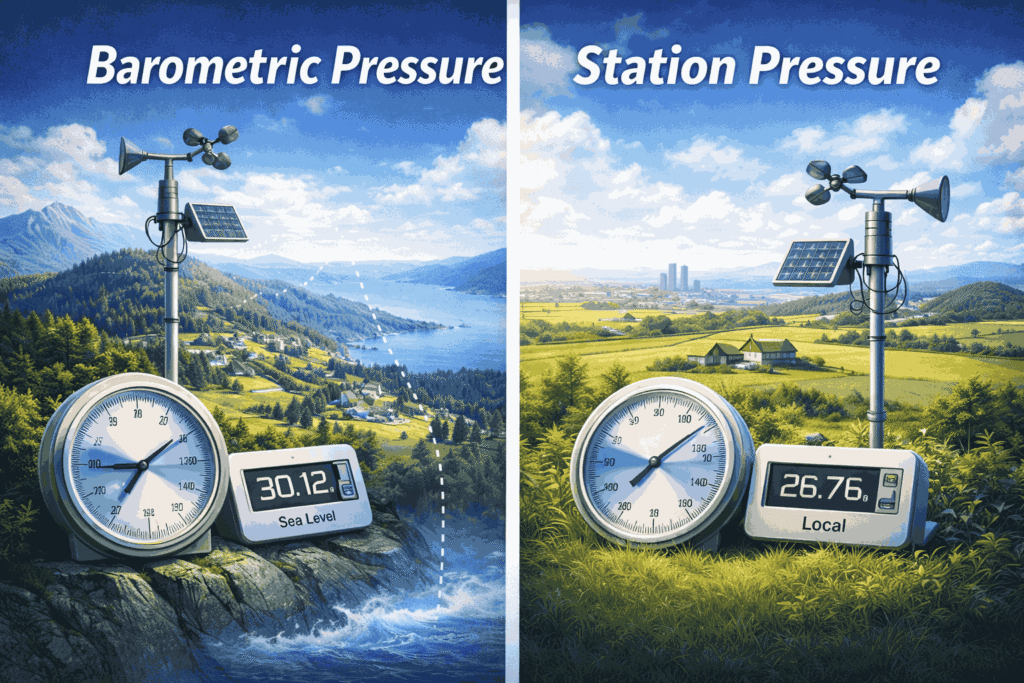

Accurate atmospheric pressure data underpins decisions in meteorology, aviation, environmental monitoring, and ballistics. Yet one source of persistent confusion remains: barometric pressure vs. station pressure.
While these terms are closely related, they are not interchangeable. Each represents a different way of interpreting atmospheric pressure, and choosing the wrong one can distort analysis, forecasts, and calculations. Understanding how these measurements differ, and when to use each, is essential for reliable data interpretation across varied elevations and environments.
Station Pressure vs. Barometric Pressure: Core Differences
At their core, the distinction lies in altitude correction.
| Measurement Type | What It Represents | Altitude Adjustment | Primary Purpose |
| Station Pressure | Actual atmospheric pressure at a specific location | No | Local analysis, ballistics, site-specific conditions |
| Barometric Pressure | Station pressure adjusted to sea level | Yes | Regional comparison, forecasting, and aviation |
Station Pressure
Station pressure is the raw atmospheric pressure measured at a given location. It reflects the true weight of the air column above the sensor, regardless of elevation. Because air pressure decreases with altitude, station pressure values naturally vary from one site to another.
This makes station pressure especially useful when local conditions matter, such as in ballistics, altitude-dependent testing, or facility-level environmental control.
Barometric Pressure
Barometric pressure takes station pressure and mathematically adjusts it to sea-level equivalent pressure. This correction allows readings from different elevations to be compared on equal footing.
Without this standardization, pressure maps and weather models would be inconsistent and misleading, especially across mountainous or high-elevation regions.
Why Sea-Level Standardization Is Essential
Sea-level adjustment is what enables comparability across geography. A monitoring station at 2,000 feet will always record lower raw pressure than one at sea level, even under identical weather conditions.
Barometric pressure correction accounts for:
- Elevation
- Temperature
- Standard atmospheric models
This ensures that meteorologists, analysts, and operators are comparing weather patterns—not geography. It’s why a forecast model in Colorado can be interpreted alongside data from Florida without distortion.
Application Comparison Across Key Industries
Meteorology
Meteorologists rely on barometric pressure to identify pressure systems, forecast storms, and model wind behaviour. Falling pressure often signals the approach of a low-pressure system, while rising pressure indicates stabilizing conditions.
Station pressure, by contrast, is rarely used for regional forecasting because it cannot be reliably compared across elevations.
Aviation
In aviation, barometric pressure directly affects altitude readings. Aircraft altimeters depend on sea-level-corrected pressure to determine height above mean sea level. Even minor pressure discrepancies can translate into significant vertical error during takeoff or landing, particularly in mountainous regions.
Ballistics
Ballistic calculations often prioritize station pressure, since projectile behaviour depends on the actual air density at the firing location. However, shooters frequently convert readings to barometric pressure when standardizing data across ranges or training environments.
Sensor Accuracy and Measurement Reliability
Pressure measurement accuracy depends on more than calibration alone. Environmental stress, temperature fluctuations, altitude variations, and long-term sensor drift all affect data integrity.
High-quality barometric pressure sensors address these challenges through:
- Temperature compensation
- Rugged, sealed enclosures
- Long-term stability calibration
- Industrial communication compatibility
In regulated or safety-critical environments, such as wastewater facilities, laboratories, or controlled agriculture, precision directly influences operational decisions and system performance.
Final Perspective: Choosing the Right Pressure Reference
The difference between station pressure and barometric pressure is not academic. It shapes:
- How data is interpreted
- Which sensors are specified
- How systems are designed and validated
Station pressure delivers local accuracy. Barometric pressure delivers comparative clarity. Knowing when to use each ensures better forecasting, safer operations, and more reliable environmental insight.