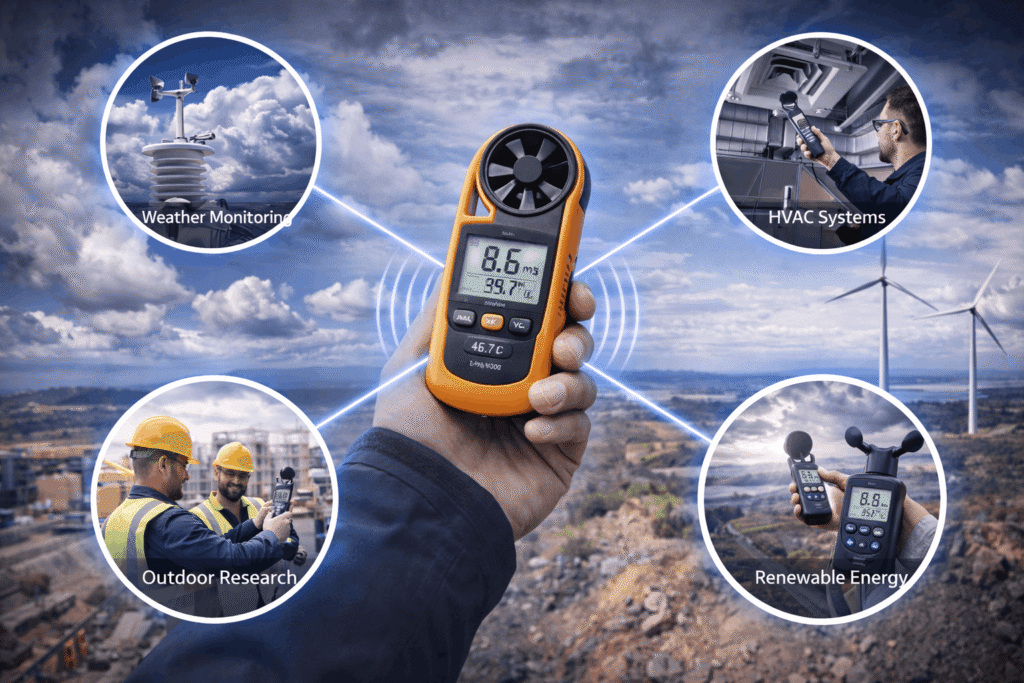

Wind conditions influence safety, productivity, and operational efficiency across industries. Sudden gusts can halt lifting operations. Variable wind patterns can reduce renewable energy output. In open-field environments, shifting air movement can affect crop performance and spraying accuracy.
Wind speed measuring devices provide data that supports operational decision-making. Reliable wind measurement supports compliance, reduces risk, and improves planning. Below are five practical areas where these devices play a critical role.
1. Construction Sites and Jobsite Safety
Construction sites operate under changing environmental conditions. Wind speed directly affects crane lifts, scaffolding stability, and work at height.
Wind speed measuring devices support:
- Real-time monitoring of gust conditions
- Safer crane and hoist operations
- Compliance with jobsite safety standards
- Reduced risk of falling materials
Many lifting operations require shutdown when wind speeds exceed specified thresholds. Accurate wind speed measuring devices help project managers pause operations before unsafe conditions develop. This reduces the risk of injury and prevents structural damage during installation.
2. Renewable Energy and Wind Resource Assessment
Renewable energy projects depend on consistent wind data. During pre-development, wind speed measuring devices assess wind resource potential across a proposed site.
They assist with:
- Long-term wind profiling
- Turbine siting decisions
- Performance validation
- Operational efficiency monitoring
Wind resource assessment requires reliable measurement over extended periods. Even small variations in average wind speed can significantly affect projected energy output. Ongoing monitoring also supports turbine performance analysis and grid integration planning.
3. Agriculture and Open-Field Operations
Agricultural operations rely on weather awareness. Wind speed directly influences pesticide and fertilizer application. High winds increase drift risk and reduce application accuracy.
Wind speed instruments help agricultural operations:
- Monitor drift conditions before spraying
- Reduce chemical waste
- Improve crop coverage consistency
- Protect neighboring properties
Consistent wind data supports compliance with environmental regulations related to spray drift. It also improves operational timing for planting, irrigation, and harvesting activities in exposed environments.
4. Industrial Facilities and Building Operations
Industrial facilities often operate large equipment, cooling systems, and ventilation systems that interact with outdoor air movement. Strong winds can affect rooftop equipment, exhaust systems, and structural components.
Wind vane and anemometer devices contribute to:
- Monitoring rooftop mechanical systems
- Managing outdoor storage areas
- Adjusting building automation controls
- Protecting temporary structures
In some facilities, wind conditions affect emission-dispersion modeling and air-quality compliance. Integrating wind data into building automation systems improves operational efficiency and the accuracy of environmental reporting.
5. Environmental Monitoring and Research Applications
Environmental monitoring programs depend on precise weather data. Wind speed plays a role in air quality studies, climate research, and site impact assessments.
Wind measurement systems support:
- Air dispersion modeling
- Climate data collection
- Regulatory compliance reporting
- Infrastructure planning studies
Long-term data accuracy is essential in research settings. Reliable measurement helps analysts understand patterns rather than isolated events. Buy wind speed meters to improve forecasting models and policy planning.
Why Application Context Matters More Than Raw Numbers
Wind speed measurement alone does not create value. Application context determines how that data supports operational decisions.
For example:
- On a construction site, a short-term gust can stop a crane lift.
- On a renewable energy site, average wind speed affects annual output calculations.
- In agriculture, moderate winds may delay spraying by hours.
The same numerical reading carries different implications depending on the setting. Selecting wind speed measuring devices based on installation environment, durability requirements, and integration needs ensures data remains actionable rather than informational.
Selecting wind-speed measurement devices based on installation environment, durability requirements, and integration needs ensures that data remains actionable. Industrial-grade wind speed anemometers support long-term monitoring, system integration, and regulatory compliance across construction, energy, agriculture, and environmental applications.