
Biotech R&D depends on speed, accuracy, and repeatability. Yet many labs continue to rely on aging automation that was never designed to support today’s throughput demands or workflow complexity. As pipelines expand and experiments become more interconnected, outdated systems can quietly erode productivity.
Professional software companies often work with labs that assume automation alone is enough—until bottlenecks, manual workarounds, and data gaps start affecting results. Recognizing when it’s time to upgrade lab automation equipment is critical to maintaining momentum in modern biotech research.
Sign 1: Equipment Bottlenecks
One of the clearest signs your automation is falling behind is recurring bottlenecks. If instruments frequently sit idle waiting for upstream or downstream steps, your workflow is no longer optimized. Older automated lab equipment often lacks the coordination needed to keep processes moving smoothly.
Common symptoms include:
- Plates are waiting too long between steps
- Instruments competing for shared resources
- Limited throughput during peak workloads
These bottlenecks slow experiments and reduce overall equipment utilization. Modern automation platforms are designed to orchestrate multiple devices in parallel, ensuring tasks are executed in the most efficient sequence possible.
Sign 2: Manual Intervention Still Required
Automation should reduce manual effort—not shift it elsewhere. If scientists still need to manually transfer plates, restart instruments, or adjust timing between steps, your system isn’t delivering full value.
Older lab automation equipment often requires frequent human intervention due to rigid programming or a lack of coordination between devices. This increases the risk of errors, introduces variability, and pulls scientists away from higher-value analytical work.
Companies help labs move toward automation environments where routine tasks run end-to-end without constant oversight. Reducing manual touchpoints improves reproducibility and allows teams to focus on experimental design and interpretation.
Sign 3: Integration Issues
Modern biotech labs rely on ecosystems—not standalone tools. If your automation struggles to connect with scheduling software, LIMS, or newer instruments, it’s a strong indicator that an upgrade is overdue.
Integration challenges often show up as:
- Incompatible communication protocols
- Custom scripts required for basic coordination
- Limited visibility across workflows
Today’s lab automation robots are designed to integrate seamlessly with other systems, enabling coordinated workflows rather than isolated execution. Without this connectivity, labs lose efficiency and flexibility as workflows evolve.
Sign 4: Data Gaps
Data integrity is as important as execution. If your automation cannot reliably capture timestamps, instrument status, or run history, you may be operating with incomplete or inconsistent records.
Data gaps can lead to:
- Difficulty troubleshooting failed runs
- Limited traceability for audits or validation
- Reduced confidence in experimental outcomes
Modern automated lab equipment generates detailed, structured data that integrates directly with laboratory data systems. This level of visibility supports better decision-making and strengthens compliance readiness across R&D operations.
How Modern Lab Automation Robots Solve This
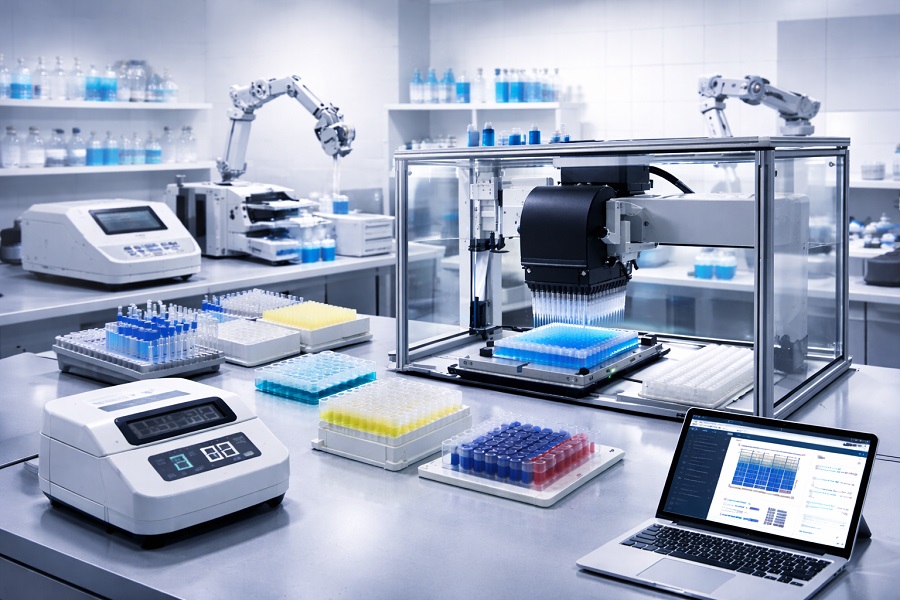
Upgrading to modern lab automation robots addresses these challenges by shifting automation from task execution to workflow orchestration. Instead of managing devices independently, newer systems coordinate instruments, timing, and data flow as a unified process.
Key advantages include:
- Dynamic scheduling: Tasks adjust automatically based on availability and completion status
- Reduced downtime: Instruments stay active and productive
- Seamless integration: Robots communicate with software, incubators, readers, and storage systems
- Improved data capture: Every action is logged and traceable
Companies work with biotech teams to modernize automation without unnecessary disruption. We help labs evaluate existing infrastructure and introduce scalable lab automation equipment that integrates cleanly with current workflows while supporting future expansion.
Conclusion
Outdated automation doesn’t always fail loudly—but it steadily slows progress. Bottlenecks, manual workarounds, integration issues, and data gaps are clear signs that your automation strategy needs attention.
By upgrading to modern lab automation robots, biotech labs can restore efficiency, improve reproducibility, and prepare for more complex workflows ahead. If you’re evaluating how to modernize your automation hardware, explore the scalable, integrated solutions.