
Accurate environmental measurements often determine the reliability of engineering decisions. Industries that depend on weather monitoring often require precise atmospheric data to plan operations.
One parameter that strongly influences many calculations is air density. It affects aerodynamic performance, sensor calibration, airflow modeling, and the accuracy of environmental monitoring. Field technicians rely on handheld weather meters to measure atmospheric conditions needed to estimate air density.
Understanding practical methods for measuring air density in the field helps organizations collect consistent environmental data.
What Is Air Density and Why Does It Matter?
Air density refers to the mass of air contained in a specific volume. It changes continuously depending on atmospheric conditions.
Important factors that influence air density include:
- Temperature
- Atmospheric pressure
- Humidity
- Altitude
Variations in air density influence several operational areas:
- Wind energy performance assessments
- Environmental monitoring accuracy
- Agricultural spray applications
- Airflow modeling and ventilation planning
Accurate air density data support reliable environmental analysis and consistent weather measurements.
Understanding What a Handheld Weather Meter Measures
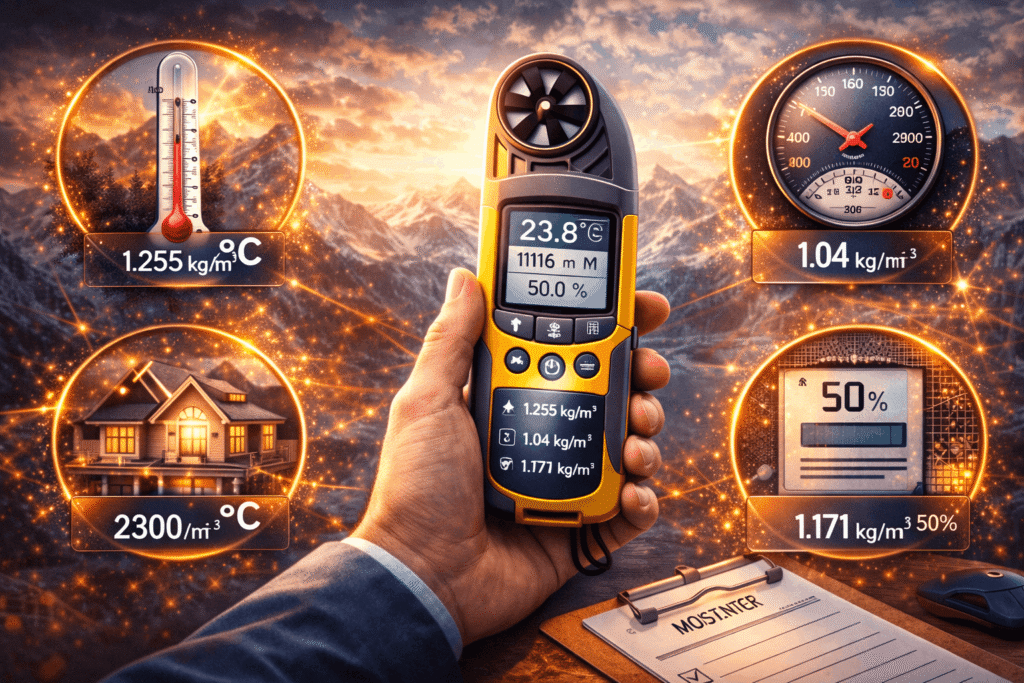
A handheld weather meter measures several atmospheric variables required to estimate air density.
Typical measurements include:
- Air temperature
- Barometric pressure
- Relative humidity
- Wind speed
- Dew point
These measurements provide the foundation for calculating air density using field-based estimation methods. Portable instruments allow technicians to gather atmospheric data at the measurement site. This avoids dependence on distant weather stations.
Method 1: Calculating Air Density Using Pressure and Temperature
A common field method estimates air density using barometric pressure and temperature. The simplified relationship is derived from the ideal gas law, which connects pressure, temperature, and density.
Basic process:
- Measure barometric pressure using the handheld weather meter.
- Record ambient air temperature.
- Apply the air density formula based on pressure and temperature.
This approach works well when humidity levels remain moderate, and the primary goal is a fast density estimate.
Advantages
- Quick field calculation
- Minimal inputs required
- Suitable for routine environmental monitoring
However, accuracy may decline slightly in environments with significant variations in humidity.
Method 2: Including Humidity for Higher Accuracy
Air contains water vapor, and humidity affects the total mass of air within a given volume. Moist air is actually less dense than dry air because water molecules weigh less than nitrogen and oxygen molecules. Including humidity improves density estimation accuracy.
Measurement process:
- Record air temperature
- Measure barometric pressure
- Capture relative humidity
These values account for water vapor pressure, yielding a more precise density estimate.
Benefits of this method
- Improved measurement accuracy
- Better results in humid climates
- Suitable for agricultural and environmental monitoring applications
Humidity-adjusted calculations are commonly used when environmental conditions fluctuate throughout the day.
Method 3: Using Altitude-Adjusted Air Density Estimation
Air density decreases as altitude increases because atmospheric pressure drops with elevation. Many field applications estimate density using altitude-adjusted models.
Procedure:
- Record site elevation or altitude
- Measure temperature and pressure
- Apply altitude correction formulas or reference tables
This method is particularly useful for:
- Renewable energy project sites
- Environmental monitoring stations
- High-elevation construction projects
Altitude-adjusted estimates help ensure that environmental data remain consistent across locations at different elevations.
Comparing the Three Methods Side by Side
Each air density estimation method offers advantages depending on field conditions.
| Method | Inputs Required | Accuracy Level | Best Use Case |
| Pressure + Temperature | Pressure, temperature | Moderate | Quick field estimates |
| Pressure + Temperature + Humidity | Pressure, temperature, humidity | High | Humid or variable climates |
| Altitude-Adjusted Estimation | Pressure, temperature, altitude | High for elevated sites | Mountain or high-elevation environments |
Field technicians often select a method based on data availability and environmental conditions.
Common Mistakes When Measuring Air Density in the Field
Even with reliable WeatherFlow weather meter instruments, measurement practices influence accuracy.
Common field mistakes include:
- Measuring too close to heated surfaces or equipment
- Recording temperature in direct sunlight
- Ignoring humidity in moist environments
- Using altitude values from distant locations
- Failing to allow the weather meter to stabilize
Consistent measurement procedures help maintain reliable environmental data across different monitoring locations.
Choosing the Right Method for Field Conditions
Selecting the appropriate air density method depends on operational requirements and environmental variables.
General guidelines include:
- Quick Environmental Checks: pressure and temperature calculations
- Humid Environments: Humidity-adjusted density calculations
- High-Elevation Sites: Altitude-corrected estimation methods
Handheld instruments simplify the process by providing the atmospheric measurements required for these calculations.
Organizations that rely on portable weather-monitoring tools can improve the accuracy of environmental data by selecting the method that best matches site conditions.
Field teams requiring portable atmospheric measurement capabilities can contact Comptus. Contact today for handheld weather instruments that provide real-time environmental readings and support accurate air-density estimation.