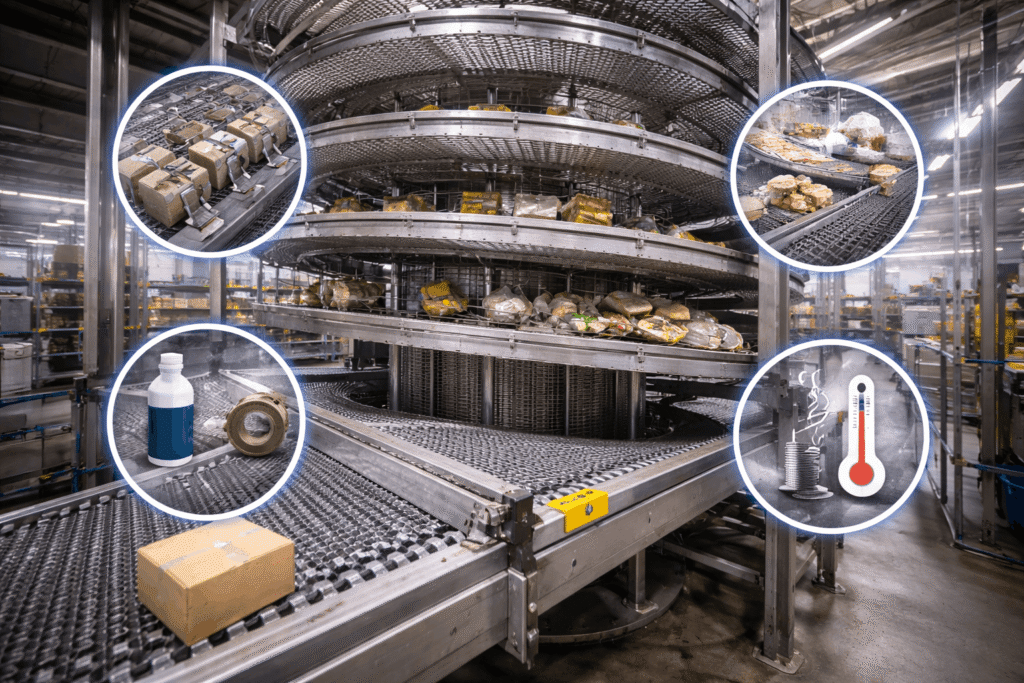

Vertical conveying systems often operate under constant pressure. They move products continuously, manage elevation changes, and operate in compact footprints where downtime quickly becomes costly. For spiral conveyor manufacturers, belt life and system reliability are not secondary considerations. They define whether a spiral system delivers long-term value or becomes a recurring maintenance concern.
A spiral conveyor belt is exposed to unique stresses compared to straight conveyors. Continuous curvature, sustained tension, and repetitive loading create wear patterns that demand careful design and disciplined operation. Understanding the factors that influence belt life helps operations reduce failures, control maintenance costs, and maintain consistent throughput.
Understanding the Role of the Spiral Conveyor Belt
The spiral conveyor belt serves as both the transport surface and the structural element that enables vertical movement. Unlike straight runs, the belt must flex laterally while maintaining tensile strength and tracking accuracy. Any imbalance in material, tension, or geometry directly affects belt longevity.
1. Belt Material Selection
Material choice determines resistance to abrasion, fatigue, temperature, and chemical exposure. Plastics, composites, and metal belts each behave differently under continuous curvature. Selecting materials that align with product type and operating conditions is essential for long service life.
2. Conveyor Load and Product Weight
Load consistency plays a major role in belt performance. Excessive product weight or uneven loading increases tensile stress and accelerates elongation. Over time, this leads to tracking instability and premature belt replacement.
3. Spiral Conveyor Design and Geometry
Effective spiral conveyor design balances diameter, tier spacing, and belt width to distribute forces evenly. Tight radii increase lateral stress, while poorly spaced tiers amplify friction. Geometry decisions made during design directly influence long-term belt behavior.
4. Belt Tension and Take-Up Configuration
Proper tension ensures traction without overstressing the belt. Inadequate tension causes slippage and wear, while excessive tension accelerates fatigue. Well-engineered take-up systems help maintain balance as operating conditions change.
5. Drive System Alignment and Power Transmission
Misaligned drives introduce uneven force across the belt surface. This results in edge wear, noise, and heat buildup. Accurate alignment and consistent power transfer are critical for stable belt operation.
6. Speed and Throughput Requirements
Higher speeds increase friction and heat generation. When throughput targets exceed design limits, belt materials degrade faster. Speed selection must reflect realistic production demands rather than peak capacity alone.
7. Environmental Conditions
Temperature, humidity, and airborne contaminants affect belt performance. Cold environments increase brittleness, while high heat accelerates material fatigue. Environmental exposure must be considered during system specification.
8. Sanitation and Cleaning Practices
Frequent washdowns introduce moisture and chemicals that impact belt materials and components. Cleaning methods must align with belt construction to prevent swelling, cracking, or loss of tensile strength.
9. Maintenance Frequency and Inspection Practices
Routine inspections identify early signs of wear such as fraying, elongation, or tracking drift. Consistent maintenance schedules extend belt life by addressing minor issues before they escalate.
10. Product Transfer and Infeed/Outfeed Conditions
Smooth transitions at infeed and discharge points reduce impact forces on the belt. Poorly aligned transfers create localized stress, leading to surface damage and structural fatigue.
Common Failure Patterns in Spiral Conveyor Belts
Common failure modes include edge wear, cracking, elongation, and tracking instability. These patterns often trace back to design oversights, improper tensioning, or mismatched operating conditions.
How Proper Design Extends Spiral Conveyor Belt Life
Systems designed with balanced geometry, appropriate materials, and controlled tension distribute stress evenly across the belt. This reduces localized wear and stabilizes long-term performance.
Best Practices for Maximizing Belt Life and Reliability
Consistent loading, correct speed control, disciplined cleaning procedures, and proactive inspections form the foundation of reliable spiral conveyor operation. Integration between mechanical design and daily operation is critical.
Reliability Starts Before the Belt Is Installed
Spiral conveyor reliability is determined long before production begins. Material selection, geometry, tension strategy, and operating conditions shape belt performance from day one. Conovey delivers engineered spiral systems designed for durability, efficiency, and predictable performance.
Connect with Conovey to build a spiral conveyor solution that supports long belt life, reduced downtime, and consistent vertical material flow.