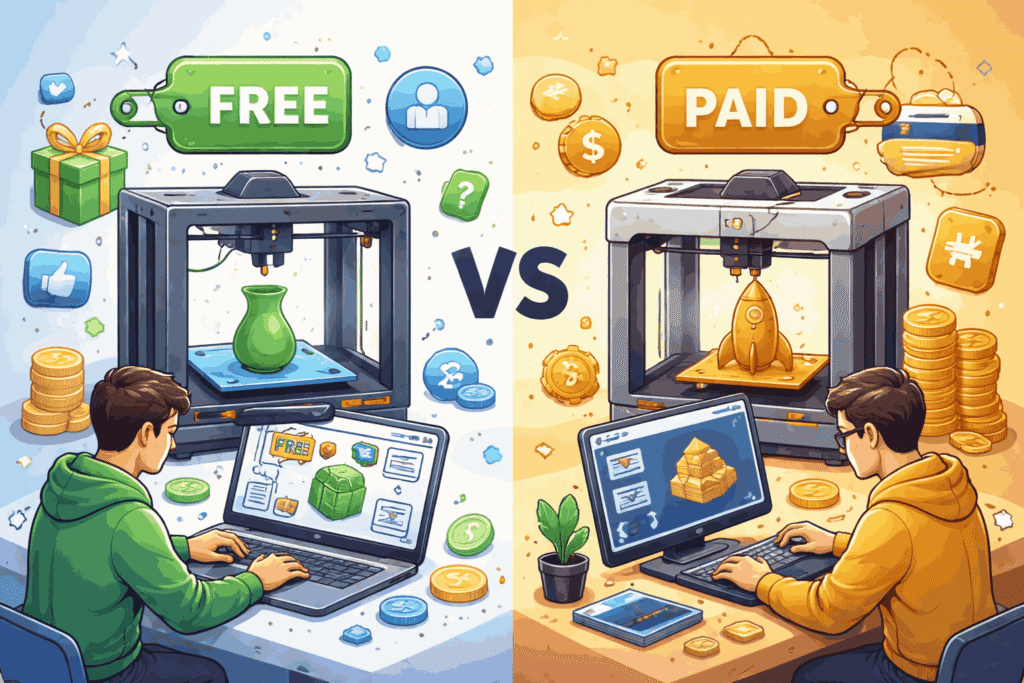

Does paying for 3D printer software truly change print quality and workflow efficiency? Many makers and institutions begin with free tools, then question whether premium platforms justify the investment. The difference often becomes clear when production demands increase.
Free tools handle basic modeling and slicing tasks. Paid platforms, however, expand control, automation, and collaboration. The choice affects performance, scalability, and long-term reliability. Understanding the differences helps teams select the right solution for structured growth.
1. Feature Depth and Advanced Tools
Free software typically includes core modeling and slicing capabilities. Paid platforms often offer advanced simulation, detailed slicing control, and optimized print profiles.
Comprehensive 3D printer design software may include parametric modeling, advanced mesh repair, and precision tolerance controls. These features matter in professional settings where repeatability and structural integrity remain critical.
2. Ease of Use and User Interface
Many free tools prioritize simplicity. While helpful for beginners, limited customization may restrict workflow flexibility.
Paid 3D printer software frequently includes refined dashboards, structured navigation, and guided configuration tools. Clean interfaces reduce user errors and shorten training time in schools and enterprise environments.
3. Technical Support and Customer Service
Free platforms rely heavily on community forums for troubleshooting. Response time varies, and documentation may lack depth.
Paid solutions usually provide dedicated support channels, onboarding assistance, and technical documentation. Reliable support reduces downtime and protects production schedules.
4. Software Updates and Long-Term Development
Free tools evolve through community contributions. Update frequency depends on volunteer efforts.
Paid 3D printer software follows structured release cycles with planned improvements and compatibility testing. Predictable development ensures long-term stability for growing organizations.
5. Integration with Printers and Ecosystems
Free basic programs may support only a limited set of printer models. Advanced ecosystems support broader hardware compatibility and centralized control.
Integrated platforms combine 3D printer design software, slicing, monitoring, and file management into a single environment. This integration reduces workflow fragmentation.
6. Cloud Access and Remote Printing Capabilities
Most free tools operate locally. That setup limits remote access and centralized monitoring.
Paid solutions often include cloud access, remote print management, and multi-device coordination. Centralized control improves efficiency in classrooms and print farms.
7. Security and File Protection
Free tools may lack robust permission management. Sensitive files can circulate without restrictions.
Enterprise-level 3D printer software includes user authentication, role-based access, and encrypted file storage. These safeguards protect intellectual property and maintain compliance standards.
8. Workflow Automation and Efficiency
Free platforms require manual file handling and printer assignment. Human intervention increases error risk.
Paid systems provide automated queue management, standardization of slicing, and usage tracking. Automation streamlines repetitive tasks and enhances operational clarity.
9. Scalability for Teams and Print Farms
Free tools work well for individual users. Scaling beyond one workstation becomes complex.
Professional 3D printer software supports multi-user environments, centralized dashboards, and quota controls. This scalability enables institutions and enterprises to manage fleets efficiently.
10. Total Cost of Ownership
Free software eliminates licensing fees. However, hidden costs may arise through downtime, manual oversight, and fragmented workflows.
Paid platforms involve subscription fees but often reduce material waste, configuration errors, and labor overhead. Total value depends on operational scale and performance expectations.
Choosing the Right 3D Printer Software for Your Needs
Free tools provide a strong starting point for hobbyists and small projects. Paid solutions support structured growth, automation, and enterprise-grade management. The right decision depends on production volume, security needs, and collaboration requirements.
Platforms such as 3DPrinterOS combine centralized management, slicing control, monitoring, and team-based access in one system. Structured oversight improves reliability and reduces operational friction.
Selecting the right 3D design software for 3D printer environments ensures consistent output, stronger collaboration, and measurable efficiency.
Streamline print workflows with 3DPrinterOS today.